
Time zones play a crucial role in how the world coordinates activities, yet many people don’t fully understand how they came to be. The system of time zones we use today was designed to make scheduling and global communication easier. But how are time zones actually determined, and why do they differ so much across the world? This article explores the factors that led to the creation of time zones and why they are so important in modern life.
In the 19th century, local solar time was the standard, meaning that each area set its clocks according to the sun’s position. However, with the advent of trains and telegraphs, this system became increasingly inefficient, especially for scheduling. The growing complexity of global communication and transport led to the creation of a standardized system. Keep reading for more information on this topic.
The History Behind Time Zones
The concept of standardized time zones was first proposed by Sir Sandford Fleming in the 1870s. Fleming’s plan aimed to divide the world into 24 time zones, each separated by 1 hour. Before this, each region had its own local time, which varied with longitude, creating confusion for travelers and businesses.
The system was formalized in 1884 at the International Meridian Conference. During this conference, it was decided that the Prime Meridian at Greenwich, England, would serve as the starting point for all time zones. The establishment of this system was essential in making global travel and communication more efficient.
Understanding how time zones were formalized and their impact on the world helps explain the global coordination needed today.
The Role of the Prime Meridian
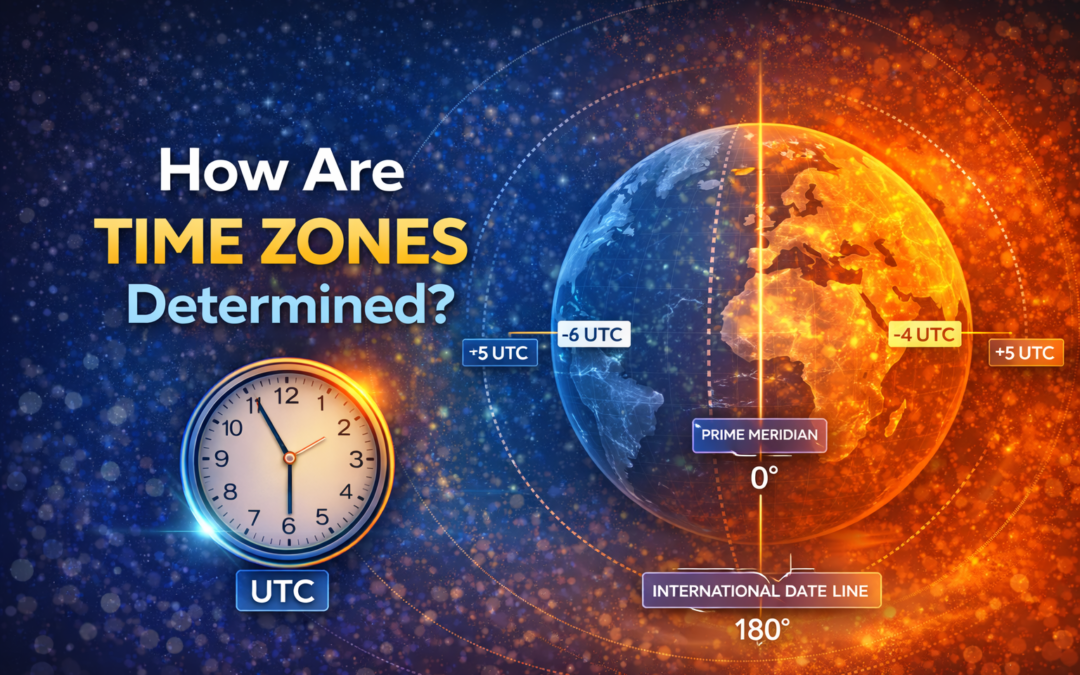
The Prime Meridian at Greenwich serves as the fundamental reference for determining time zones. It is considered the “zero” longitude, from which all other time zones are measured. The world is divided into 24 time zones, each representing one hour of time difference from the Prime Meridian.
While the division of the world into time zones is based on longitude, countries often adjust time zone boundaries for political and economic reasons. For instance, China, despite spanning five time zones, operates under a single time zone, China Standard Time, to unify the country under a single standard. This shift illustrates the complex balance between geography and political decisions in the time zone system.
The Prime Meridian’s role in establishing global timekeeping provides a framework that aligns international business and travel schedules.
Political and Economic Factors in Time Zone Determination
While time zones are based on geographical coordinates, they are heavily influenced by political and economic factors. Countries may adopt time zones that best fit their national interests or align with trading partners. For instance, India uses a single time zone across the country, even though its vast geography would suggest the need for multiple zones.
Economic considerations also play a significant role in establishing time zones. Some countries adopt time zones that facilitate business coordination with neighboring regions. For example, Spain uses Central European Time (CET), despite its location being better suited to Western European Time, because of its historical alignment during World War II.
The influence of political and economic factors on time zone decisions demonstrates the system’s flexibility in serving national and global needs. For example, you can learn more about time zone arrangements in the United States, which uses several time zones to cover its wide geographic expanse.
The Impact of Daylight Saving Time
Daylight Saving Time (DST) adds another layer of complexity to time zones. By shifting clocks forward during the summer months, DST helps make better use of daylight and conserves energy. This practice, initially introduced during World War I, is still observed by many countries, though not universally.
The start and end dates for DST vary by country, causing temporary shifts in time zone differences. For example, the United States and Europe observe DST, but many countries near the equator or those with minimal daylight variation throughout the year do not. These shifts can complicate global coordination, requiring businesses and governments to stay up to date on local time changes.
To understand more about how DST affects global timekeeping and scheduling, study why the first day of spring changes for the reasons behind the changing first day of spring each year.
Time Zone Differences and Their Global Impact
Time zone differences affect a wide range of activities, from scheduling meetings to coordinating travel and trade. As the world is divided into multiple time zones, regions are ahead or behind others by several hours. This makes it essential to consider these differences when planning international communications and travel.
As businesses increasingly operate across borders and remote work becomes more common, time zone coordination has become a critical aspect of global operations. Tools such as time zone converters and world clocks have become essential for professionals working across multiple time zones. These tools help ensure that meetings and projects run smoothly, regardless of time differences.
For those working within the U.S., managing time zone differences efficiently is crucial. You can master handling these challenges with a helpful tool that simplifies time zone coordination in the U.S., such as Master American Time Zones.
Unusual Time Zone Practices
In some parts of the world, time zone practices do not follow the standard system of one-hour increments. Instead, fractional time zones are used, adding 30 or 45 minutes to the typical time difference. Countries like Iran, India, and Newfoundland have adopted these fractional time zones for various historical or political reasons.
These fractional time zones can cause confusion because they don’t follow the typical 15-degree increment rule. India, for instance, operates at 5 hours and 30 minutes ahead of GMT, while Newfoundland is 3 hours and 30 minutes behind GMT. Such variations make global time coordination more complex but are implemented to suit the specific needs of each region.
The Future of Time Zones
As technology continues to evolve and global communication expands, the system of time zones may need to adapt. Innovations in digital tools and systems could change the way we manage time zone differences in the future. However, time zones will likely remain a fundamental part of global coordination, ensuring that people around the world stay synchronized.
Despite technological advancements, time zones continue to serve a practical purpose in everyday life. As long as there are multiple time zones, it will be crucial for businesses and individuals to manage time differences effectively. Time zone adjustments may become easier with better tools, but the underlying system will likely persist for the foreseeable future.
Conclusion
Time zones are an essential part of our global society, allowing for coordination in travel, business, and communication. From their creation in the 19th century to their ongoing evolution today, time zones help us manage our increasingly interconnected world. Understanding the factors that determine time zones, from geography to political decisions, allows us to navigate time differences more efficiently.
Though time zones may seem like a simple concept, they involve complex considerations and historical decisions. As the world becomes increasingly interconnected, managing time zones will remain critical for global business and communication.