
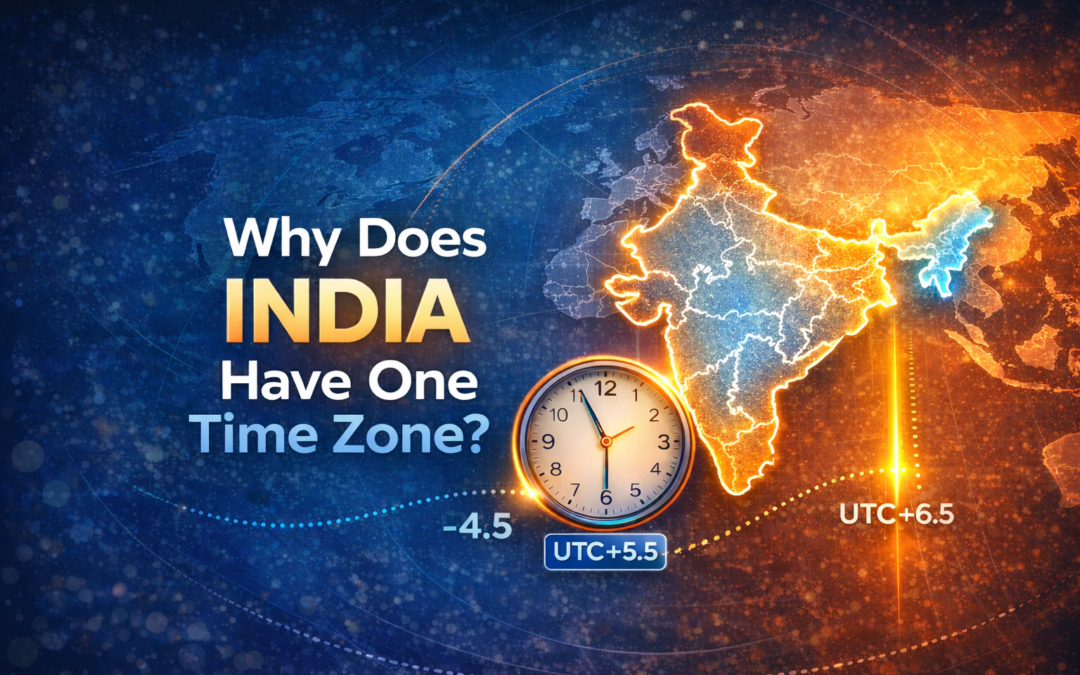
India, despite its vast geographical expanse, uses only one time zone, Indian Standard Time (IST). The decision to adopt a single time zone rather than multiple ones is a complex historical and administrative choice.
This system simplifies coordination across the country, but it also presents challenges for some regions. Here, we discussed why India has one time zone, so you can understand better. Read on!
Historical Background of India’s Time Zone
The roots of India’s single time zone go back to British colonial rule. When India was under British governance, a unified time zone was introduced to streamline administration and communication across the empire. This practice persisted after India gained independence, as it was considered a symbol of unity and simplicity.
Historically, the country operated on local times based on the sun’s position. However, the introduction of a single, standard time helped streamline transportation, communication, and business practices across India’s vast regions. The decision to keep this system intact has helped avoid the complications that arise from maintaining multiple time zones.
One key aspect of this administrative choice is the ability to manage the country’s diverse and large geography under one unified schedule. This has helped maintain national unity and communication, ensuring consistent policies across all states. Additionally, this decision has facilitated India’s ability to manage logistics and national projects efficiently. For further insight into how time zones can impact national operations, understanding why the first day of spring changes can offer valuable perspectives on how time is perceived and coordinated globally.
The Impact of a Single Time Zone on Daily Life
The most significant challenge of a single time zone is the misalignment of sunrise and sunset times across different parts of the country. While the eastern regions of India experience daylight several hours earlier than the western regions, everyone follows the same time. This leads to inefficiencies, particularly in the use of daylight.
However, despite these challenges, the central government believes that the benefits of a unified time zone outweigh the drawbacks. For example, businesses across the country can operate on the same schedule, improving coordination. Additionally, national broadcasting and media can maintain consistency, as there is no need to adjust for regional time zones.
In regions like the northeast, where sunrise happens early, businesses often adjust their operating hours to better utilize daylight. With the help of time zone resources like how many time zones in USA, people can also adjust their schedules to align with varying daylight conditions. These technologies help mitigate some of the inconveniences caused by the single time zone.
Advantages of a Single Time Zone for India
One of the key advantages of a single time zone is the simplification of governance. Managing one time zone means that all government offices, transportation systems, and industries operate on the same schedule. This ensures that national programs and policies are implemented consistently across all states.
Moreover, a unified time zone eliminates the confusion and administrative burden that could arise from having multiple time zones. It also facilitates smoother communication between various government departments and helps in conducting national elections without worrying about time zone differences.
The decision to stick to a single time zone also supports economic activities. For instance, companies can hold conferences and meetings without needing to consider time zone differences. In essence, the convenience of managing a single time zone has allowed India to maintain operational efficiency in a complex nation.
Why the Eastern States Feel the Effects of One Time Zone
While a single time zone may be advantageous for administrative purposes, it is particularly challenging for people in the northeastern states of India. The easternmost parts of India, such as Assam and Arunachal Pradesh, experience sunrise earlier than the western regions by several hours. As a result, people in these areas often start their day in darkness during the winter months.
This time mismatch creates an issue where the people in the eastern part of the country experience daylight much earlier, while the western regions like Gujarat, Maharashtra, and Rajasthan are still in darkness. The result is an imbalance in energy usage and daylight productivity across regions. Although some have advocated for a second time zone to accommodate these disparities, the move has yet to gain traction.
Despite these issues, the central government has maintained that the benefits of national unity and simplified coordination outweigh the difficulties experienced by the eastern regions. It remains a subject of debate among policymakers and experts.
Calls for a New Time Zone
Over the years, there have been calls for the introduction of a second time zone for India. These proposals often focus on addressing the challenges faced by the northeastern states, where early sunrise hours can be unproductive. Some experts believe that introducing a second time zone could improve energy efficiency and productivity in those regions.
However, the proposal has faced resistance due to concerns about administrative complexity. Implementing a new time zone would require substantial changes to schedules, laws, and systems across the country. Despite these challenges, the debate continues, and many believe that the issue may eventually need to be addressed for the betterment of regional development.
The Role of Technology in Mitigating the Disadvantages of One Time Zone
In modern times, technology has played a crucial role in mitigating the inefficiencies caused by a single time zone. With the advent of digital communication and flexible work hours, businesses and individuals can now adapt their schedules to accommodate the varying daylight hours. For instance, businesses in the eastern parts of the country can adjust their working hours to align with the early sunrise times.
Technology has also allowed for the development of tools that help people manage time zone differences in a way that accommodates their specific needs. Master American Time Zones is an example of a resource that helps people adjust to different time zones and ensure they stay in sync with global operations. With such tools, the challenges of a single time zone can be minimized.
The Debate Over Multiple Time Zones in India
While many see a single time zone as a symbol of national unity, others argue that it is inefficient for a country as large and diverse as India. The debate continues on whether a second time zone would improve life in the eastern and northeastern regions of India. Proponents of multiple time zones believe that it would make daily activities more efficient, from school timings to business hours.
However, changing the time zone system would require overcoming substantial hurdles. Introducing multiple time zones would mean significant changes to India’s current administrative and operational structure. This could lead to complications in national logistics, media, and coordination between states.
Conclusion: One Time Zone for National Unity
India’s decision to use a single time zone is primarily a matter of national unity and administrative simplicity. While the disadvantages, such as inefficiency in daylight usage in the eastern regions, are evident, the benefits of coordinating on a single time zone are substantial. The government remains steadfast in its approach, though the debate continues as to whether a second time zone might better serve India’s diverse regions in the future.
India’s use of a single time zone is a decision rooted in history, practicality, and the need for unity. As the country continues to grow and modernize, it is likely that the debate over time zones will continue. However, for now, the country’s single time zone remains an important symbol of national cohesion.